
It weighs 27 grams.
It works at 1600 kg.
Seven things owners changed their mind about after fitting one. The words on this page are theirs, taken from their reviews. The footage is filmed on their boats. The numbers come from the technical sheet.


One machined aluminium ring, one groove for the line, and a rubber sheath around the outside. The rubber is the whole point, and it is the reason this page exists.
Andrea wrote it better than we could: he had never tried low friction rings because friends had told him they were dangerous, for the damage they do to the boat when they bang on the gel coat.
They were not wrong. A bare aluminium ring on the end of a loaded sheet is a hammer waiting for the next gust, and it always lands on the same gel coat you paid for.
Then he saw the rubber sheath, made up his mind, and now writes that he could not live without them. Here is what changes.
Do not take our word for it. Watch it.
Same boat, same afternoon, spinnaker up. The red sheet is running through the ring at full load. No edit, no music, no voiceover.
Your friends are right: a bare ring marks the deck.
Patented double rubber sheath
This one is wrapped in it. The aluminium never touches the boat, so the ring can swing, drop and land where it wants: on the gel coat, on the teak, against the mast, on the coachroof.
It is the single thing owners write about most. Patrick: the double rubber sheath is what tells Olli apart from the others, and finally no more scratches and breaks on his boat. Thomas ordered them for a new boat, where the yard had suggested sticking protective patches on the deck instead.
Nobody buys a ring because of a rubber ring. They buy it because they have already repaired a piece of gel coat once.

Where it actually lives: a padeye, a lashing, and a deck it is going to touch a thousand times this season.
You think a ring cannot replace a block.
A block has a sheave, a bearing, cheeks, a pin and a service interval. A ring has a groove. Andrew had never used one before, replaced some of his blocks with these and calls it a great solution. Asli, who uses them for everything from leading spare sheets aft to acting as a preventer, put the objection to bed in one line: it feels like using a normal block, they do not feel any extra resistance.
The reason is the groove itself: hard black anodized aluminium 6082, polished by the process, sized for the line it is meant to carry. It does not spin because it does not need to.

The line sits in the groove. That is the entire mechanism, and there is nothing in it that can seize.
You think 27 grams cannot hold anything.
1600 kg working, 3200 kg breaking
Those are the numbers of the S, the one that weighs 27 g and takes a 10 mm line. The M weighs 50 g and works at 3200 kg. The L weighs 128 g and works at 6400 kg. Every size breaks at twice its working load.
Put differently: the smallest one in the range holds more than a tonne and a half and disappears in your palm. Five sizes, XS to XL, so the rig gets the ring it needs and not the one that was in the drawer.

XS to XL, side by side. Claes went up one size after two seasons on the older ones, which is the normal way people find their size.
The honest comparison
| A block | Olli Ring | |
|---|---|---|
| Weight aloft | Hundreds of grams of metal and bearing | From 27 g |
| What can fail | Bearing, sheave, pin, cheeks | Nothing moves |
| When it hits the deck | Metal on gel coat | Rubber on gel coat |
| Maintenance | Rinse, lubricate, check the bearing | Rinse |
| Cost per turning point | The price of a block | From 19 EUR |
You think it is a racing part.
Look at what owners actually rigged with them, in their own words:
- A preventer, and leading spare sheets from the bow back to the cockpit.
- A barber hauler, with a soft touch on the topsides.
- Guy leads for a symmetric spinnaker on a Beneteau First 405.
- The pole topping lift, then six more for sheets and halyards.
Henry is the one who bought six more. He started with one, as an experiment, on the topping lift.

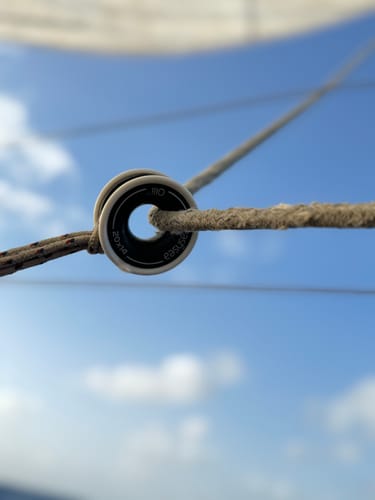
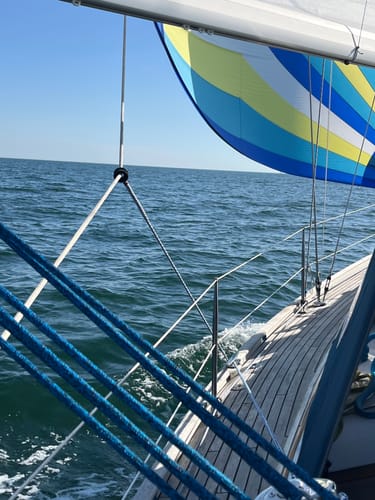
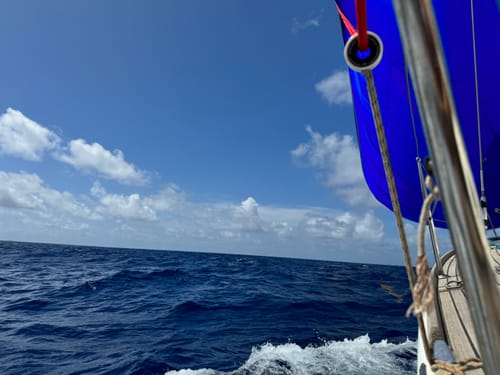
Two of them on the same run, at sea. Nobody stops at one, and at this size nobody has to.
Where owners put them
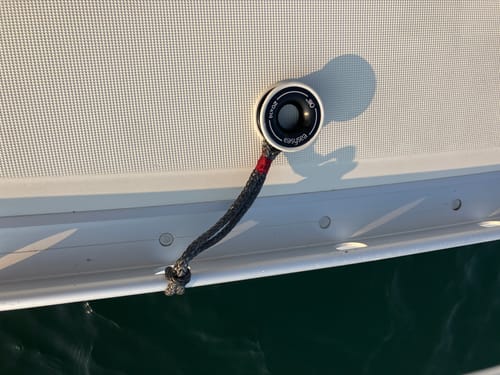
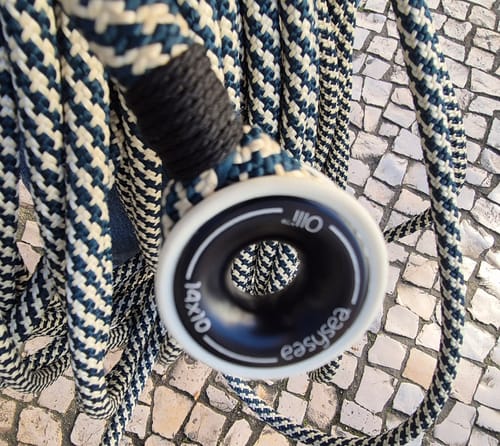
Photos uploaded by customers with their reviews. Not our shoot, not our boats.
You think something with no bearing will chew the line.
There is no bearing to fail because there is nothing to fail. What carries the load is the surface itself:
- Aluminium 6082, CNC machined, the same alloy used for structural marine parts.
- Hard black anodizing, a treatment that leaves a hard, smooth, corrosion resistant surface where the line runs.
- A groove sized for the line, 10, 14 and 20 mm on S, M and L.
- TPU impact protection outside, which is the part that meets your deck.
Nothing to lubricate, nothing to service, nothing that can seize in August. Rinse it with the rest of the deck gear.

The groove, up close. That surface is the whole engineering of this product.
You think you will find out how good it is at the worst possible moment.
101 owners got there first: 4.7 out of 5, and a DAME Design Award nomination in 2023. Joshua examined his at length and wrote that the rubber is the real game changer, and that it no longer makes sense to buy rings from other brands.
They are not all five stars, and the ones that are not are still below, in their words: one owner saw the rubber start to peel after a few races, another finds the outer walls thicker than they need to be now that everybody is using Dyneema. Nothing on this page was picked to hide that.

Fitting one takes a lashing and a minute, which is also why people end up with six.
The one in the locker is the one that saves the passage.
A block lets go, a car jumps its track, a lead is suddenly in the wrong place and you are a long way from a chandlery. A spare block only helps if you also have the right pin and a free padeye. A ring and a length of Dyneema make a turning point out of anything strong enough to tie to.
That is why owners keep more than two on board. At 27 grams and from 19 EUR, the spare costs less than the fitting it replaces and takes up no room at all in the locker.

A ring, a lashing, a strong point. It is a jury rig you can do in the dark with one hand on the boat.
What owners say after they use it
"I had never tried low friction rings because many friends had told me they were dangerous because of the damage they could do to the boat by banging on the gel coat. I saw Olli and finally made up my mind. I couldn't live without them anymore, one of the best upgrades on board this year!"
Verified buyer, customer photo
"It doesn't scratch the hull, which is a huge plus. It feels like using a normal block, we don't feel any extra resistance. Highly recommend it!"
Verified buyer
"I liked it right from the start: I took it as an experiment to rig the pole's topping lift, and from there I've taken another 6 which I'm using on board for sheets and halyards. Excellent product!"
Verified buyer
"Nice block with the rubber protection but it has started to peel off after only a few races."
Verified buyer, 4 stars
"The additional protection that Olli offers is exactly what I needed. The double rubber protection sheath is a feature that distinguishes Olli from the others. Finally, no more scratches and breaks on my boat."
Verified buyer
"They just arrived, for my new boat, I couldn't stand the idea of seeing scratches on a new boat, the shipyard had advised me to put protective patches to avoid scratches on the deck. But when I showed them these, they fell in love with them too."
Verified buyer
The numbers
Questions everyone asks
Will it mark my deck like the bare ones do?
That is the reason the rubber sheath exists. The aluminium is wrapped in a patented double rubber sheath, so what meets your gel coat, your teak or your mast is rubber. It is the single feature owners write about most in their reviews.
Can a ring really replace a block?
For a turning point, yes, and owners here have done exactly that. What you give up is the free running of a bearing under very high, very repeated loads, which matters on a primary winch lead. What you gain is no moving parts, a fraction of the weight and no maintenance.
Which size for my line?
By line diameter: S takes a 10 mm line, M takes 14 mm, L takes 20 mm, with XS and XL either side of them. If you are between two sizes take the larger one: the working load goes from 1600 kg to 3200 kg and you are still holding 50 grams.
How do I attach it?
With a Dyneema lashing or a soft shackle through the centre hole, onto a padeye, a toe rail, a mast base or any strong point you already have. No pin, no tools, nothing to drop in the water.
How long does the rubber last?
On most boats it outlives the season without a mark. One owner racing hard saw his start to peel after a few races, and his review is on this page: if that happens to you, write to us, the product is covered by the easysea three year warranty.
Does it wear the line?
The groove is hard black anodized aluminium, sized for the line diameter it is rated for, which is what keeps the bearing surface smooth and the load spread. Use the size that matches your line and keep the turning angle sensible, exactly as you would with a block.


Both photos are from the same day on board, with the rings doing the job they were bought for.
Still repairing gel coat every autumn?
Two options. Keep the bare metal rings and the blocks that mark the deck every time the load comes off. Or fit 27 grams that work at 1600 kg, land on rubber, and that 101 owners have already had a season with.
Olli Ring, the anti-shock low friction ring. Five sizes, from 19 EUR, in stock.
Get the Olli RingSummer Sale · 15. → 31. August
Summer Sale.
Summer-Sale-Preise auf das gesamte Sortiment. Rabatt bereits im Preis, kein Code nötig. Am 1. September gilt automatisch wieder der Listenpreis.